Family Disaster Preparedness in Hispaniola: A Decade of Progress
Today we would like to share with you one of our longest-running programs that is concluding this fall. It began with a shared interest between GHI and the U.S. Geological Survey (USGS) in putting USGS science to work to prepare communities on the Caribbean island of Hispaniola for earthquakes.
This 10-year effort, reaching over 168,000 people thus far, is at the heart of what we do. The program’s objective—to provide families in Hispaniola with science-based, locally relevant, actionable disaster preparedness information—reflects our deep commitment to serving those most at-risk.
Hispaniola, composed of Haiti and the Dominican Republic, is the most populated island in the Caribbean with about 24 million people. It faces multiple hazards, including earthquakes, tsunamis, landslides, floods, and hurricanes. Devastating impacts from past disasters have demonstrated the profound exposure and vulnerability of people and infrastructure.

These key questions drove our approach: How can we provide science-based information that people can trust and in ways that consider the local context and languages? How do we reach those that are often overlooked and ensure lasting dissemination?
With these questions in mind and with insights from our local staff native to our program communities, our team designed our approach as follows:
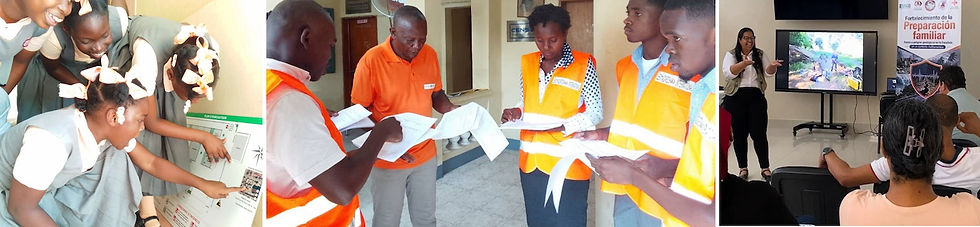
Work through social institutions that people trust and reflect the population. In Haiti, for example, we have worked with 48 churches and 44 schools so far, directly reaching close to 17,000 students. Engaging with students is particularly important, as about 50% of Haiti’s population is under 21 years old.

Partner with and strengthen key stakeholders, such as first responders, Red Cross, Civil Protection, teachers, technical experts, and other local leaders. By training 792 local leaders so far, we are ensuring that disaster resilience messages can be reinforced in the future, such as by teachers sharing information with students each year.

Integrate disaster preparedness into institutional processes and planning. For example, we co-created 24 Emergency Committees of local advocates at schools and churches, and co-developed Emergency Plans for each of their institutions. Together with other key stakeholders, they exercised their plans via drills helping to strengthen coordination.

Create a science-based, compiled source of information that can be used for years to come to support risk communication efforts. These “Sourcebooks” were generated in relevant local languages (Creole and French for Haiti; Spanish for Dominican Republic), as well as English.

Share information via localized communication channels. Basic principles include using locally relevant communication channels (e.g., call-in radio talk shows and forums, sound trucks, posters, banners) and going to where people are (e.g., public markets, festivals, beaches, schools, mass, and door-to-door outreach). We are already seeing promising progress. After the August 2021 earthquake in southern Haiti, we heard from people who knew what to do when the shaking started because of our messaging.

This long-term program has served as an anchor for our work in Haiti and the Dominican Republic, enabling our local team to invest in community relationships. Trust, built over years, allowed us to immediately serve communities affected by the 2021 earthquake. As part of this, our staff and GHI-trained community members shared science-based information on what to do during aftershocks, and collected damage data on over 12,000 buildings. The data were made freely available to humanitarian organizations and helped refine USGS post-earthquake products.
Ultimately, our work is about creating enduring disaster preparedness. In the last several months of this program, we are busy continuing to cultivate local ownership, support institutional readiness, empower and engage future generations, and strengthen coordination among key stakeholders.

Despite a deeply challenging decade in which Hispaniola experienced several disasters, the COVID-19 pandemic, and political instability in Haiti, our team has made a tremendous impact. Their inspiring dedication and resourcefulness is a testament to what can be achieved even in the most difficult of circumstances.
With gratitude,

Veronica Cedillos Janise Rodgers
President & CEO Chief Operating Officer

GeoHazards International
The joint U.S. Geological Survey (USGS) and GeoHazards International program described above was funded by the generous support of the American people, through a series of Cooperative Agreements from 2016-2026 (most recently #G26AC00060) with support from the Earthquake Disaster Assistance Team (EDAT). EDAT receives funding from the US Department of State and the USGS Earthquake Hazards Program. The views and conclusions contained in this document are those of GeoHazards International and should not be interpreted as representing the opinions or policies of the USGS.